

The spare tire well is wasted space — until you put a tray in it
News · Product release
The spare tire well is wasted space — until you put a tray in it
Maremlyn has released a range of rigid, partitioned trays that replace the void under the boot floor. Seven fitments are now listed, covering the BYD Ti 7, Atto 2, Atto 3, Sealion 7, Sealion 6, Seal 5 and the Geely EX2.
Most electric hatchbacks and SUVs built in the last five years share the same hidden compartment: the well under the boot floor where a spare wheel used to live. On most EVs it now holds a foam insert, a compressor, a bottle of sealant and a plastic bag of loose hardware. Everything slides. Nothing is where you left it.
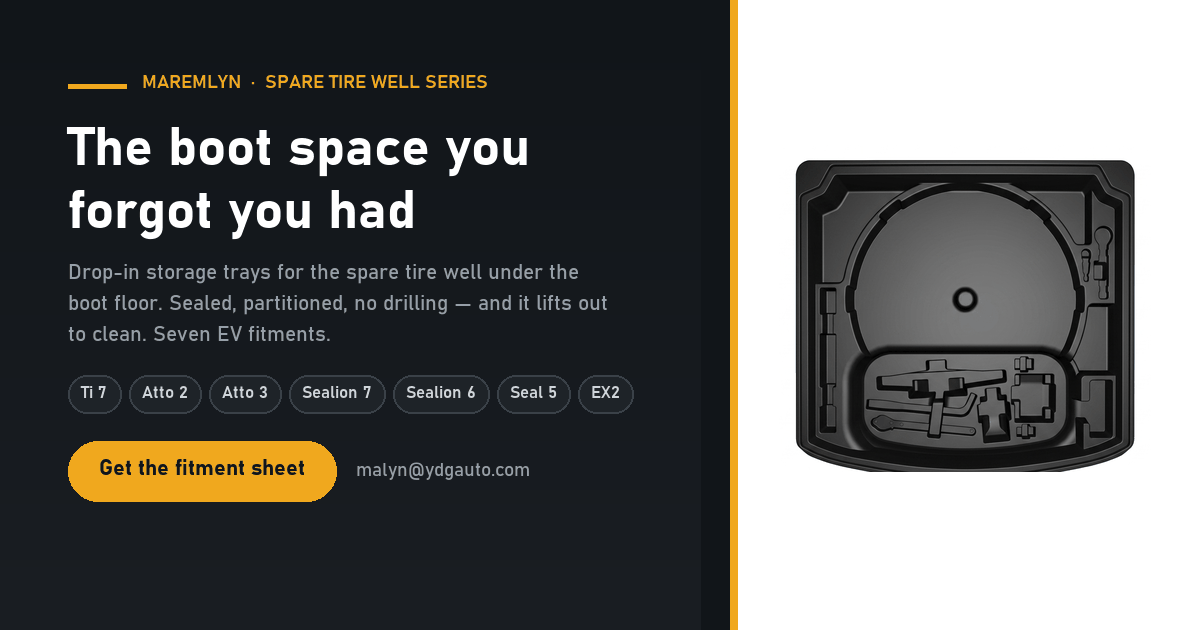
The part itself is unglamorous. A tray, moulded to the shape of one specific well, with raised lips around each bay so that a jack, a charging cable and a set of wheel bolts stay in their own compartment while the car is moving. It drops in without drilling, follows the contour of the well, and lifts out in one piece when the well needs washing.
What makes it worth writing about is not the plastic. It is what the plastic replaces.
Why the foam insert was never really storage
The foam insert that ships with most EVs is a shipping aid. It locates the inflator and the towing eye during transport, survives a drop test, and costs almost nothing to make. It was never designed to hold anything the driver actually uses.
Owners find this out quickly. The charging cable goes in loose and picks up grit from the well. The jack works its way out of its cutout and rattles against the wheel arch on rough roads. Anything wet — a folded rain jacket, a muddy tow strap — soaks into the foam and stays wet for days. And because the insert is soft, anything heavy placed on top of it compresses the tools underneath.
A rigid tray changes the physics of the compartment rather than the styling of it.
The wells are not identical either. Some cars carry a temporary spare; most now carry only sealant and a compressor. One tray has to serve both layouts without turning either into a pile.
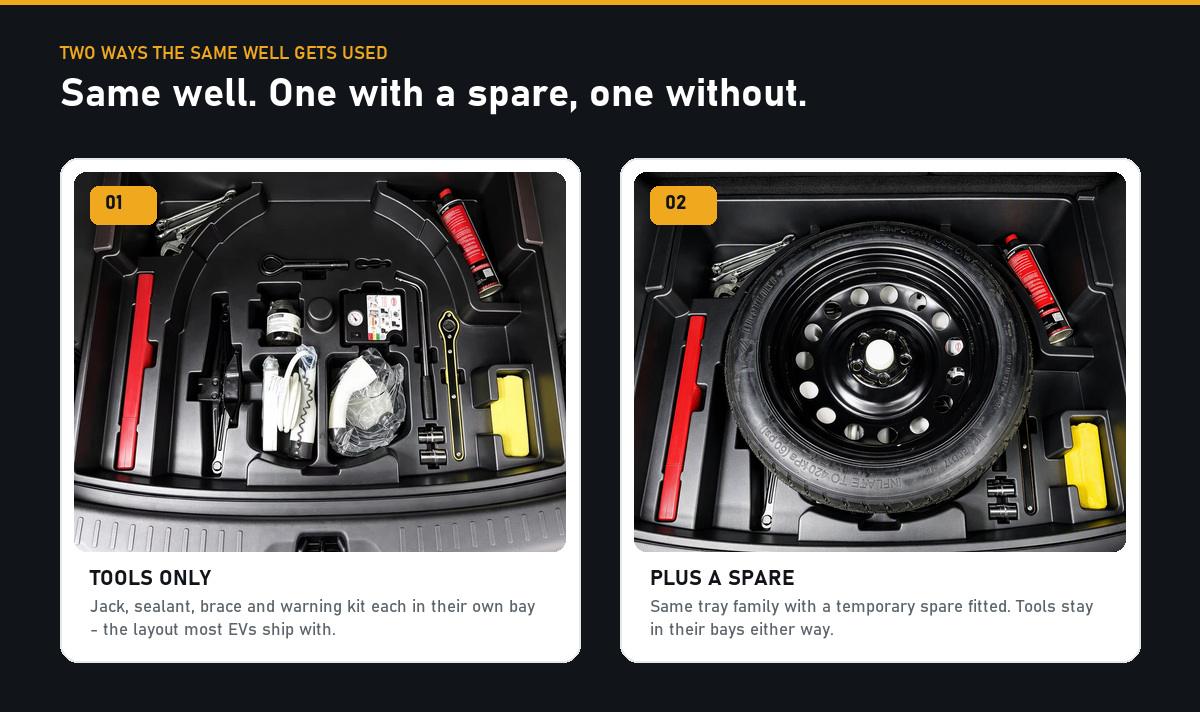
Left: tools only. Jack, sealant, brace and warning kit each in their own bay — the layout most EVs ship with. Right: plus a spare. The same tray family with a temporary spare fitted, tools still located.
Compare the two approaches and the difference is structural rather than cosmetic.
- Holds its shape under load. The foam insert compresses; the tray is compression-moulded in PP and keeps its profile, so tools underneath are not crushed by whatever sits on top.
- Handles wet and muddy kit. Foam soaks moisture in and stays damp for days. The tray's raised lip contains the wet kit, and the whole tray lifts out for washing.
- Keeps tools located. OEM cutouts loosen with use. Every item gets its own bay, so the jack is still in the jack bay after a rough road.
- Fits the floor panel. Both sit flush — the tray is moulded to the original height, so the boot cover closes as it did from the factory.
- Installs without tools. Instead of a factory-fitted insert, it is drop-in: no drilling, no trimming, and it comes back out by hand.
Seven boots, seven moulds
The mistake buyers make most often is assuming a storage box is universal. It is not. The well under a Ti 7 is a different shape from the well under an Atto 3, and the Sealion 6 uses a lower cargo deck rather than a wheel well at all. A tray that “fits most models” fits none of them properly — it will sit proud of the floor, and the boot cover will not close.
Each tray in this range is developed from a 3D scan of the original vehicle, taken in the company's Guangzhou facility, and moulded to that single model. The position differs by model — a tray inside the well, a box at the trunk side, or a lower boot deck — and the list below names which applies to which car. What does not change is the principle: the tray is cut for one body, not averaged across several.
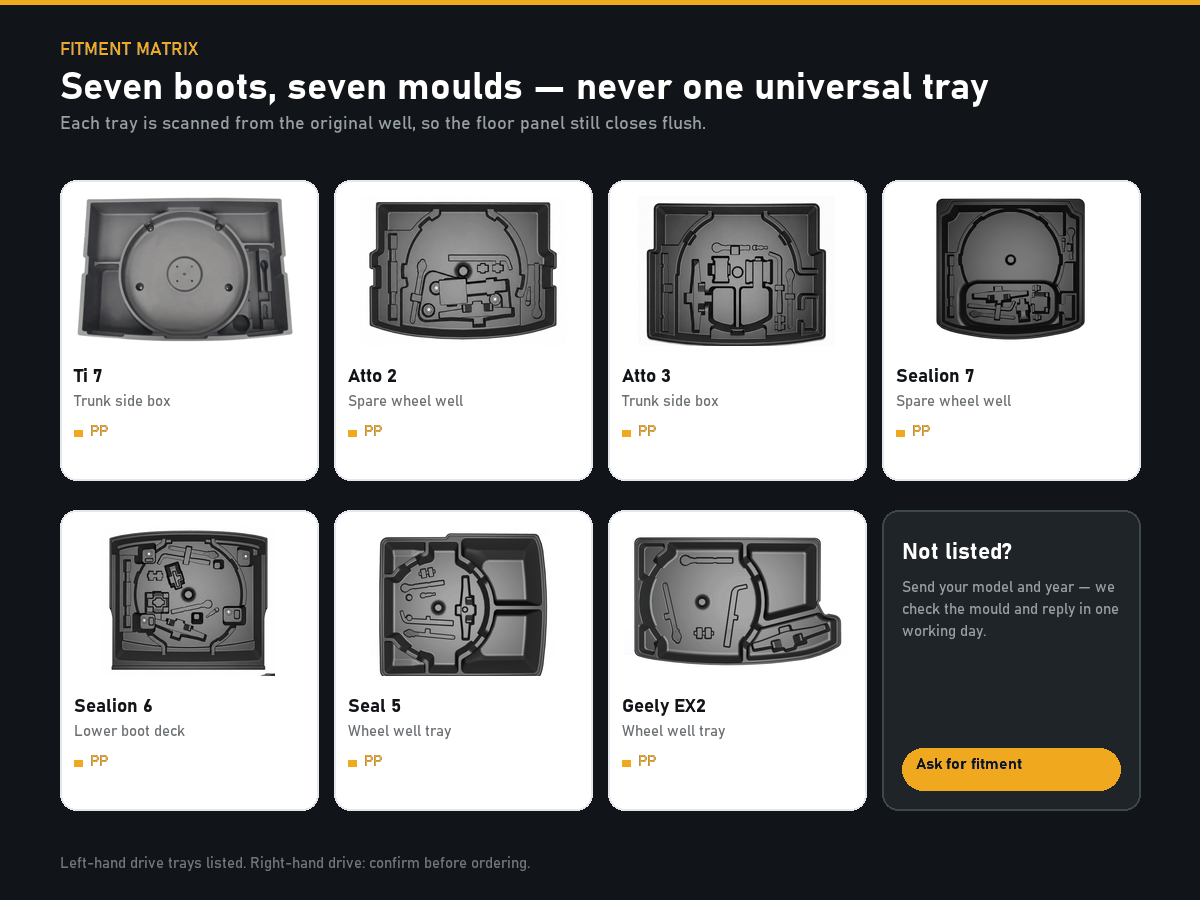
Find your boot. Seven moulds, three positions: inside the well, at the trunk side, or as a lower cargo deck. LHD trays listed — confirm drive side before ordering.
All seven are moulded in PP — one material across the range, so stock, care and cleaning instructions are identical from model to model.
- BYD Ti 7Rear trunk side box · PP
- BYD Atto 2 / Yuan UpSpare wheel well · PP
- BYD Atto 3 / Yuan PlusRear trunk side box · PP · LHD
- BYD Sealion 7 / Sealion 07Spare wheel well · PP
- BYD Sealion 6 / Song Plus ChampionLower boot deck · PP
- BYD Seal 5Wheel well tray · PP
- Geely EX2Wheel well tray · PP
What actually goes in each bay
The value of a tray is in its partitions, not its volume. On the Seal 5 and Geely EX2 versions, the layout is built around four recurring items: the charging cable, the jack, the repair kit and the wheel brace. Each gets a bay with a raised surround, so the item is located before the car moves rather than after.
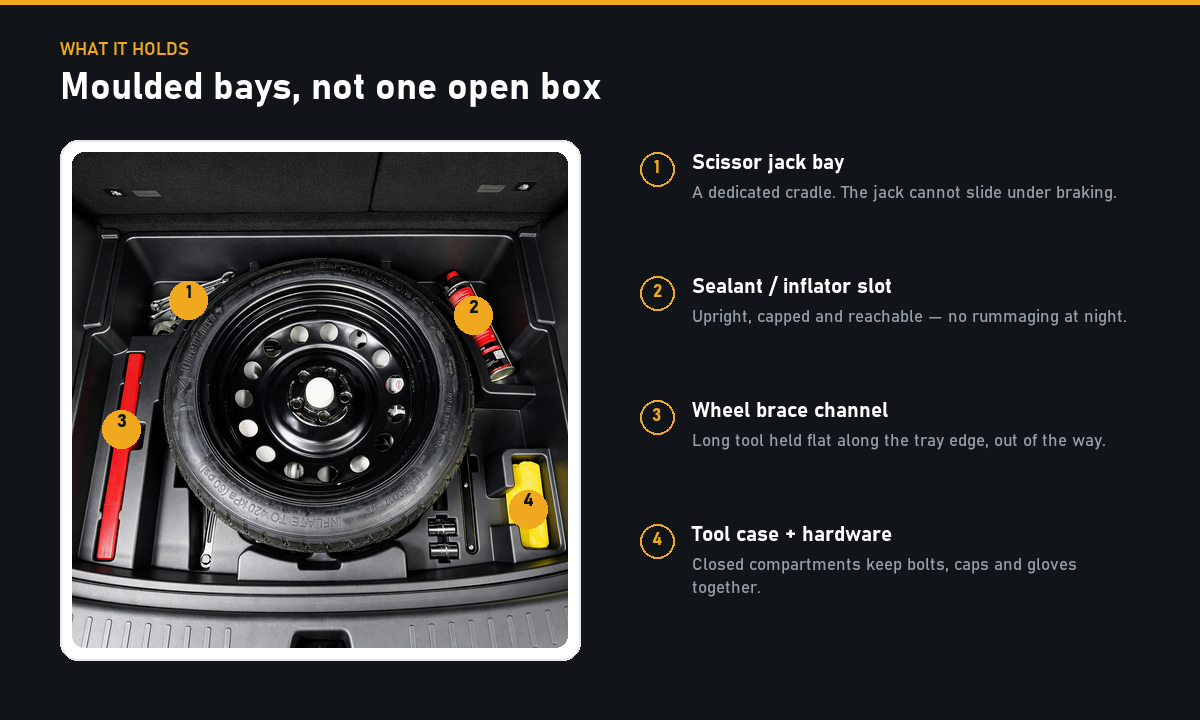
Four bays, four jobs. Jack cradle, sealant slot, brace channel and a closed compartment for bolts and gloves — so nothing has to be searched for at the roadside.
The Geely EX2 tray is a direct replacement for the soft foam insert, and is moulded so that the boot floor panel still sits flush at its original height — the tray does not raise the loading lip.
Installation: four steps, no drilling
- Lift the boot floor. Hinge the floor panel up and lift out the foam insert. Nothing is bonded or clipped in place, so it comes out by hand.
- Drop the tray in. It follows the well contour and seats one way only — there is no drilling, cutting or trimming.
- Load and locate. Cable, jack, brace and sealant each settle into their own bay.
- Close it flush. The original floor panel returns to its factory height, and the raised lip keeps grit, spills and wet kit away from everything else.
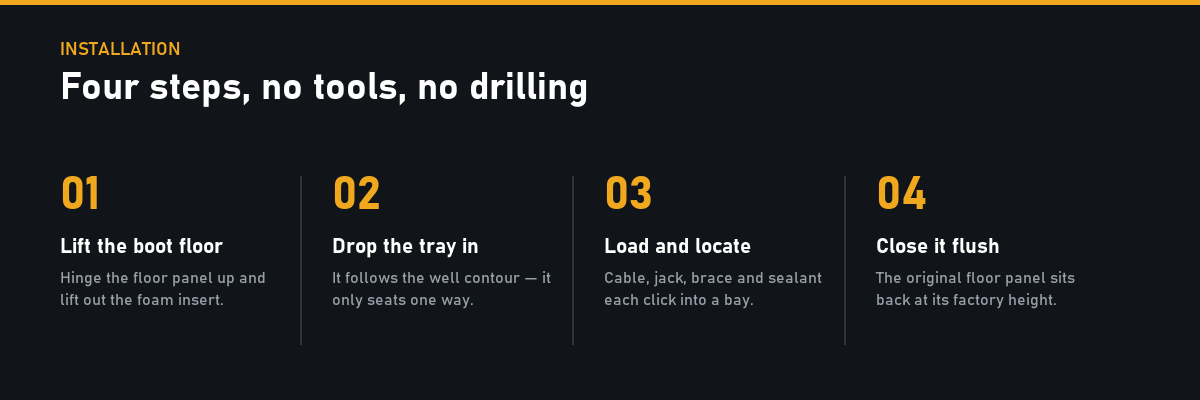
No tools required. The whole job takes minutes and reverses just as easily for cleaning.
Built for stock, not for one-off orders
The range is produced by Guangzhou Yangdugang Auto Accessories, which has been moulding new-energy-vehicle accessories in Guangzhou since 2012 and runs four production bases. Moulds are developed from 3D scans of the original vehicle, so the trays follow the real well geometry rather than a generic pattern. Bulk orders for in-stock models are typically fulfilled in 7 to 15 days.
For distributors, the practical argument is range depth: one supplier, one packaging standard, and a fitment list that covers the models actually selling in the market — Ti 7, Atto 2, Atto 3, Sealion 6, Sealion 7, Seal 5 and the Geely EX2 — instead of a single bestseller.
Frequently asked questions
Will the boot floor still close?
Yes. Every tray in the range is moulded to sit below the original floor panel height, which is why the fit is 1:1 rather than approximate.
Does it fit right-hand-drive cars?
The Atto 3 version is listed as left-hand drive. For other models, confirm the drive side before ordering — the well shape is the same, but the surrounding trim is not.
Is it waterproof?
The trays are moulded in one piece with a raised lip, so spills, wet kit and grit stay inside the tray and can be lifted out and washed. Water does not pass through the tray into the well.
Can I order mixed models in one shipment?
Yes. Bulk orders can combine models, and the standard lead time is 7 to 15 days for in-stock moulds.
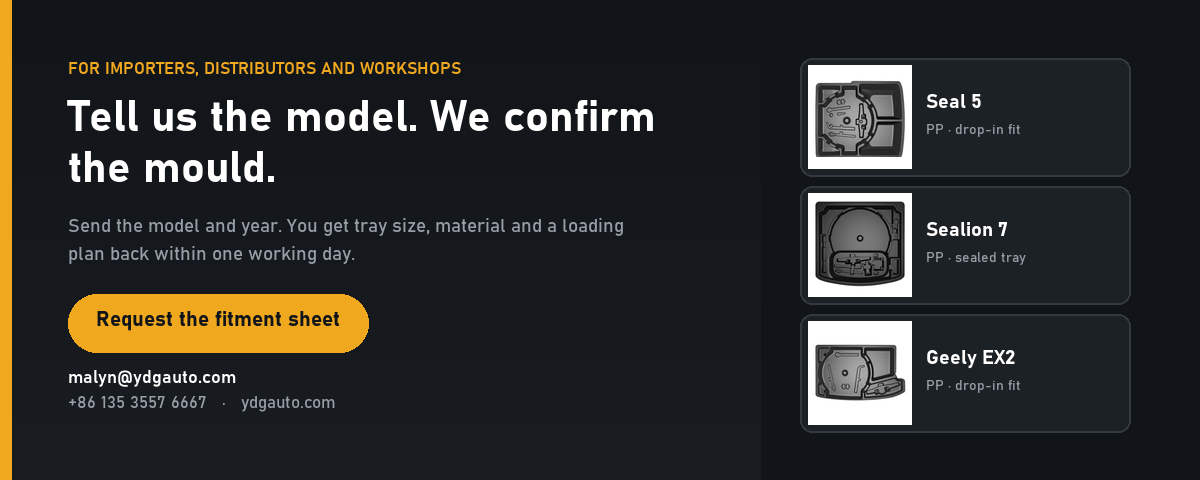
Send the model and year to [email protected], call +86 135 3557 6667, or request a quote online — tray dimension, material and loading plan back within one working day.
Related: all BYD accessories · BYD Ti 7 TPE floor mats and trunk liner · BYD Sealion 6 front frunk organizer