

One tooling set, two badges: an eight-part accessory line for the Geely Coolray and Proton X50
The same body leaves two assembly lines under two nameplates. Maremlyn has tooled a full accessory range from that body directly — so one carton can serve a Geely dealer in one market and a Proton showroom in another, in left- or right-hand drive.

The Coolray and the Proton X50 are one body under two badges. The range is tooled from that body once, then packed for either market.
Most aftermarket programmes for this platform still treat it as two cars. A supplier tools for the Coolray, then discovers the Malaysian twin needs its own moulds — or adapts a neighbouring model's part and lets the fitment notice do the explaining. The result is a catalogue that looks complete and a first container that comes back with claims.
The new range runs the other way round. Every item was scanned and tooled from the vehicle itself, in both left- and right-hand drive, so the fitment file covers the Coolray and the X50 without a second set of tooling. Eight parts, one reference, two badges.
Why the X50 twin changes the brief
A supplier selling into Southeast Asia is effectively selling into two catalogues at once. One buyer orders against "Geely Coolray", the next against "Proton X50", and a distributor covering both markets occasionally orders against both in the same container. If the parts behind those names differ, every price list has to be re-checked and every restock order doubles in complexity.
Single tooling removes that. It also removes a quieter problem: left- and right-hand drive. Floor mats, sill guards and under-guards that were only ever checked on a left-hand-drive car tend to reveal their gaps on the other side — at the customer's workshop, after the goods have cleared customs. Both configurations are covered here from the same design data.
The eight parts
The range is deliberately narrow. Rather than a long tail of small trim, it covers the parts an importer actually re-orders — the ones that take wear, and the ones that change how the car looks on a showroom floor.
- Engine under-guardAluminium-magnesium alloy. Stops stones, kerbs and water spray below the sump, with vent openings left open for heat dissipation and an anti-rust surface for wet roads.
- Mudguards, front and rearPP splash guards that take the stone chips otherwise aimed at the sills and rear bumper. Direct fit, no drilling.
- TPE floor and trunk mat comboMoulded to the floor and trunk contours. Deep channel and raised edges hold mud, meltwater and daily grit off the original carpet.
- Door sill and trunk guardStainless steel on the loading edge — the first place a used car shows its age.
- Window visors, four-piecePC with a smoke tint, so rain can be kept out with the window cracked and cabin heat stays manageable in tropical markets.
- Sport roof spoilerRear, direct fit. The change that reads first in a showroom photograph.
- Front lip and trim setCarbon-fibre pattern, for the visual step between trim levels.
- Gear-shift leather coverStitched leather over the most-touched surface in the cabin.
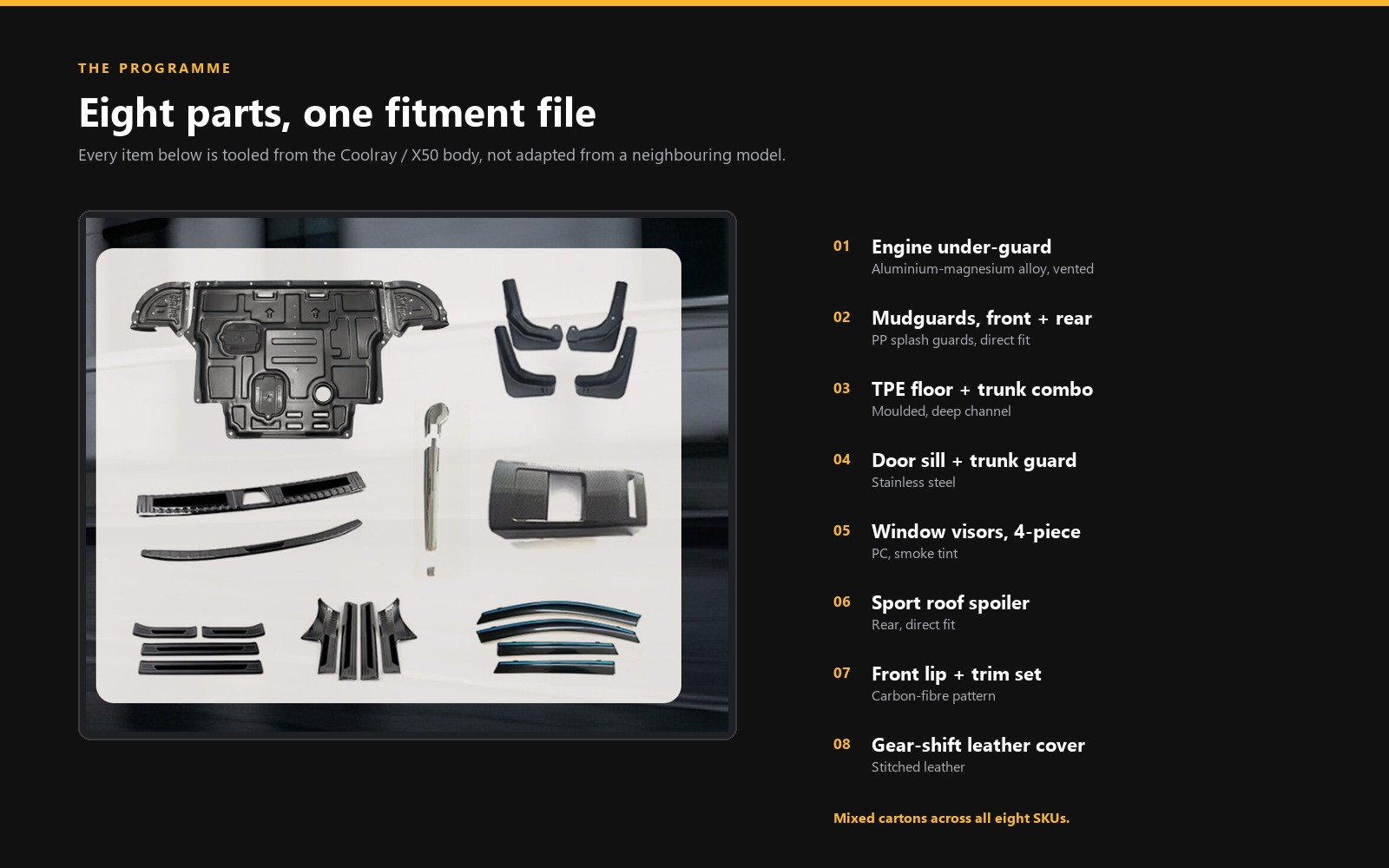
Eight SKUs, one fitment file. Everything in the shot is tooled from the same body — nothing here is adapted from a neighbouring model.
Protection first, because that is what re-orders
The floor and trunk combo is the part that decides whether a distributor comes back. It is moulded to the floor and trunk contours rather than cut to a generic pattern, so coverage runs edge to edge with no trimming at the workshop. Raised edges and a textured surface trap mud, water and debris before they reach the original carpet — which is what protects resale value on a car that will be traded in three years from now.
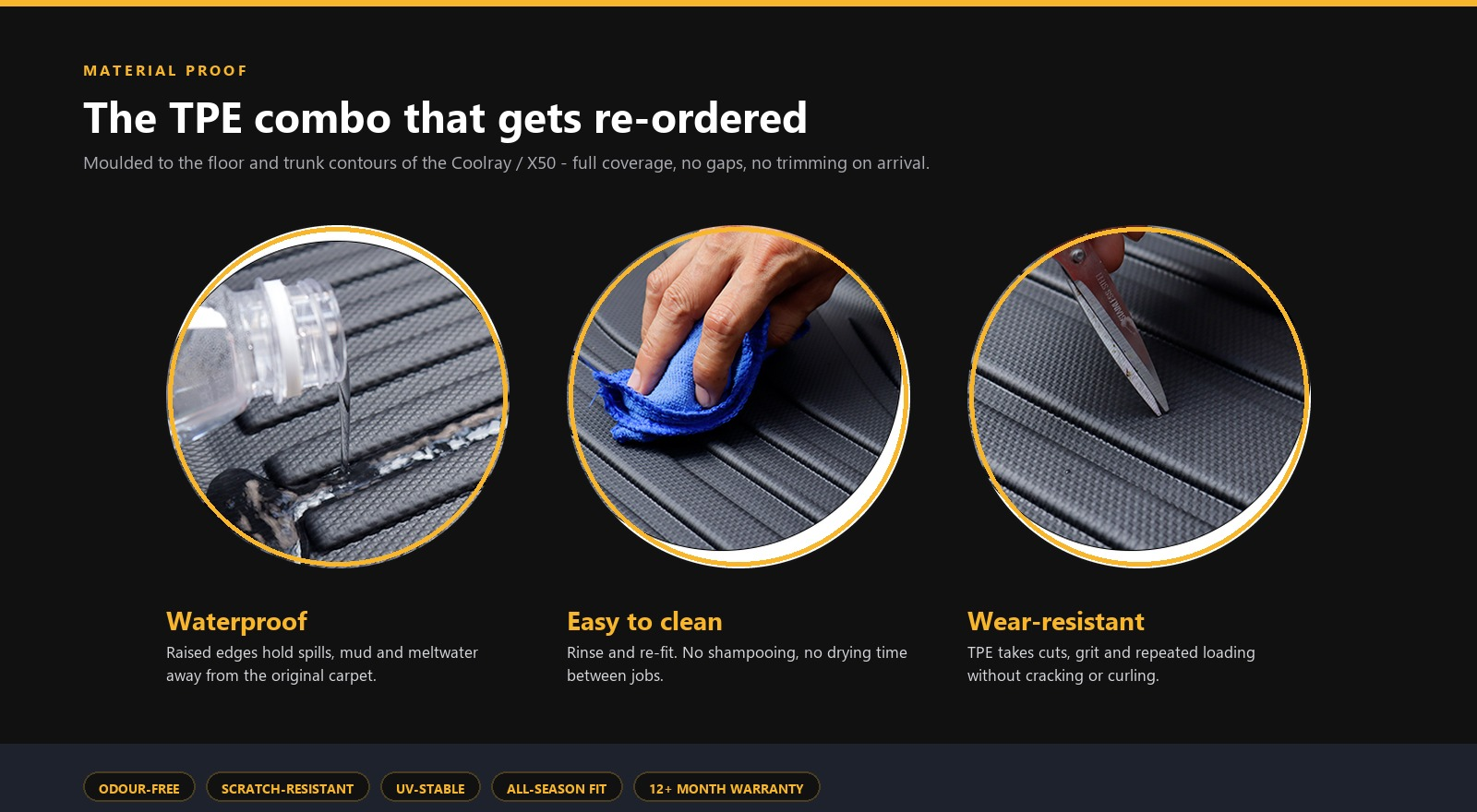
Water sits on the surface instead of soaking in; a cloth clears it; the sheet takes a cut without splitting. Moulded TPE, not a cut-to-fit rubber mat.
Underneath, the aluminium-magnesium under-guard is the second re-order item. It aligns with the vehicle's own mounting points, so there is no drilling and no bracket kit to lose in transit, and the reserved vent openings keep airflow moving so the engine bay does not heat-soak in slow traffic. The surface is treated against oxidation — the detail that matters on wet, salted or muddy roads, where an untreated plate starts to look like scrap metal within a season.
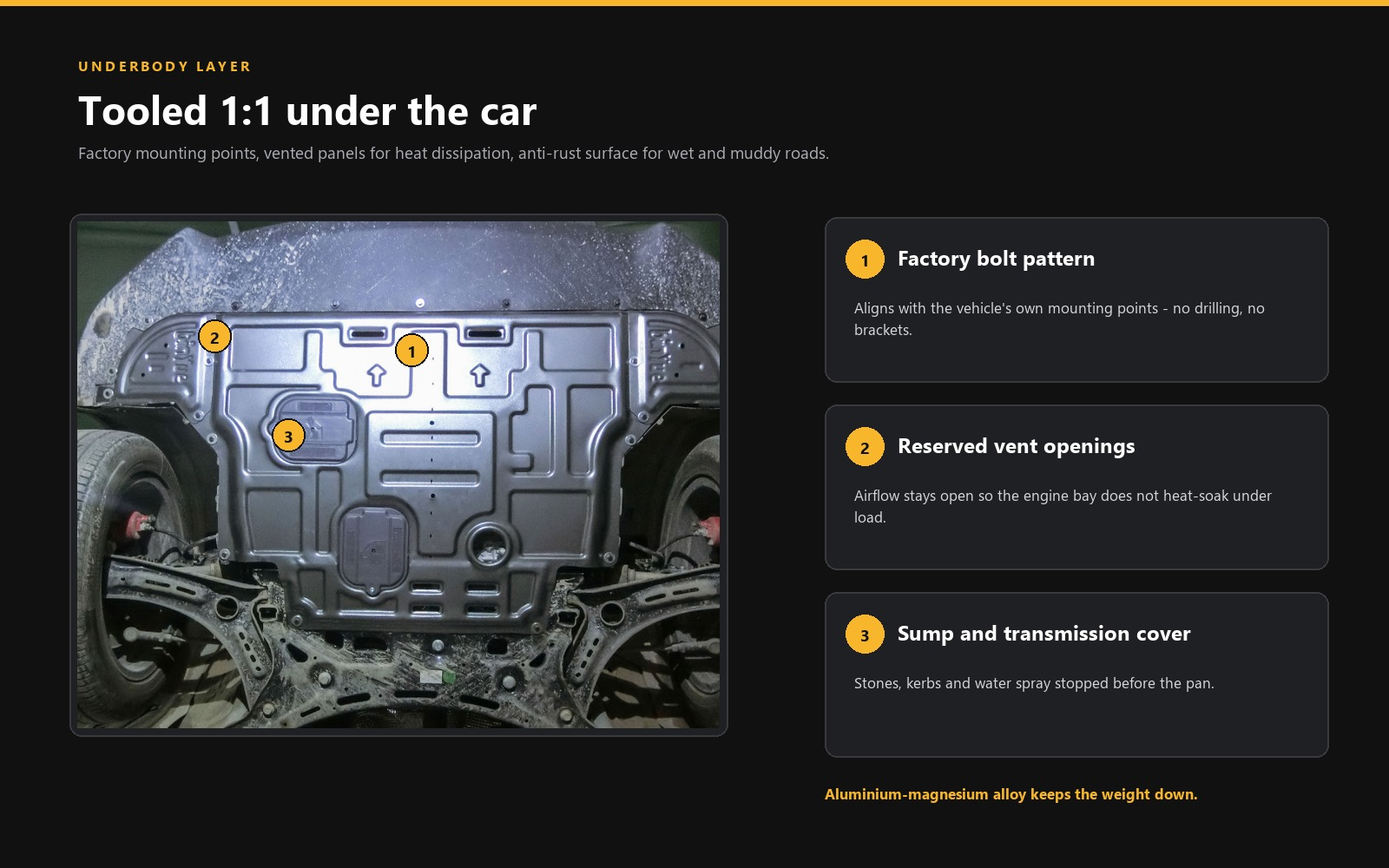
Fitted, not rendered. The plate follows the factory bolt pattern, keeps the vent openings clear, and covers the sump and transmission before anything else does.
Where cheap kits fail — heat, UV and odour
Two climates do most of the damage in this category. In tropical markets, a mat that has been sitting in a closed container for six weeks announces itself the moment the carton is opened: if the compound is not odour-free, the whole pallet smells like a tyre shop and the dealer rejects it. In desert markets, UV does the work — surfaces chalk, colours fade, and a black mat turns grey in a season.
The specification here is written for those two failures rather than for a showroom in Europe. Materials are odour-free, scratch-resistant and UV-stable, and the compound holds its shape across extreme temperatures instead of curling at the edges when it is pulled out of the car for washing. That is a boring sentence in a catalogue and the most common reason a restock order never arrives.
Fitment checks that stop claims
Wrong-fit claims cost more than the part: the return freight and the lost dealer are the real invoice. Three details, confirmed at the quotation stage, remove most of the risk on this platform.
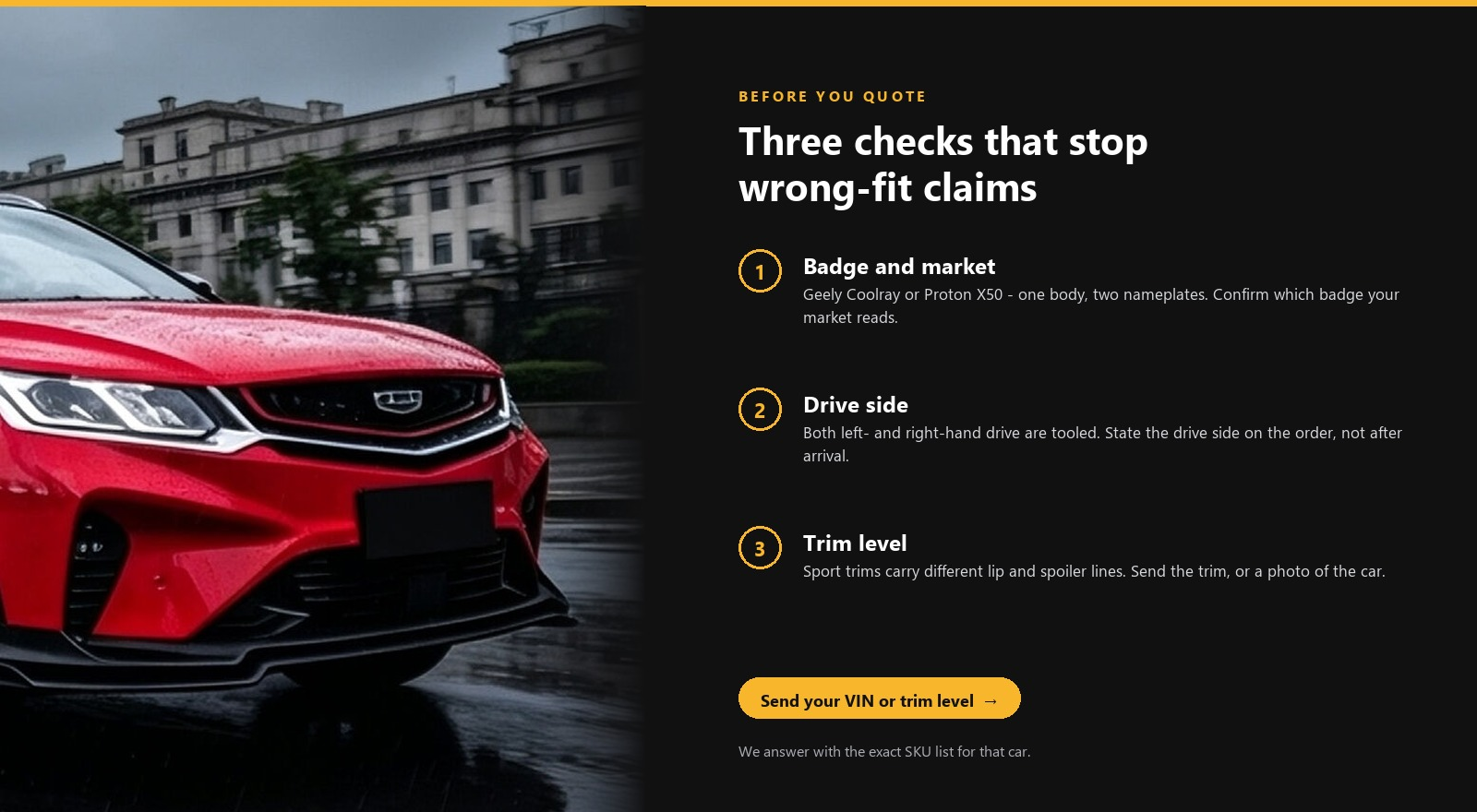
Badge, drive side, trim level. Confirming these three on the order removes most wrong-fit claims before the container is packed.
- Badge and market. Coolray or X50 — same body, two nameplates. Say which one the market reads, because the invoice and the retail listing follow the badge, not the body.
- Drive side. Both are tooled. Put it on the order rather than in the follow-up email after arrival.
- Trim level. Sport trims carry different lip and spoiler lines. A photo of the actual car settles it faster than a trim code.
Stock-keeping arithmetic
Single tooling is a working-capital argument as much as an engineering one. One reference means one safety stock covering two markets instead of two, one set of product photography instead of two, and one fitment sheet the whole dealer network can be trained on. For a distributor carrying both badges, the same shelf coverage sits behind a single SKU count.
Mixed cartons run across all eight SKUs, which is what makes a test order workable: a reseller can open with the mats and mudguards, add the under-guard once the first re-order lands, and take the appearance parts when the local trim mix justifies them. Private label is available on the same schedule as stock items.
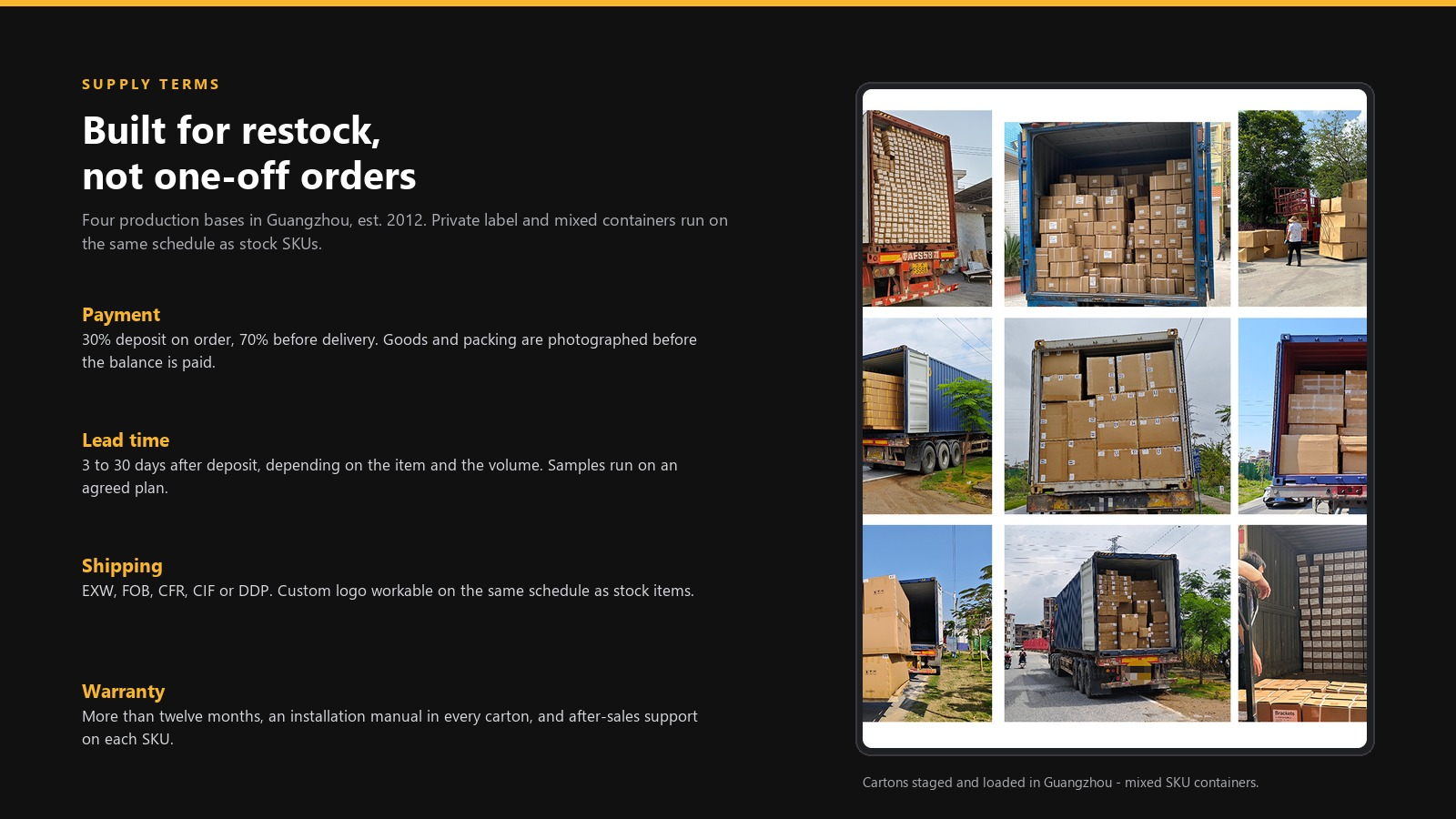
Terms in one frame: 30% deposit and 70% before delivery, 3–30 days after deposit, EXW to DDP, custom logo, and a warranty of more than twelve months with an installation manual in the carton.
The commercial structure is the one the factory has run since 2012: T/T with 30% as deposit and 70% before delivery, goods and packing photographed before the balance is paid, lead times of 3 to 30 days depending on item and volume, and shipment on EXW, FOB, CFR, CIF or DDP terms. Samples are supplied against an agreed customised plan rather than pulled from a shelf.
Built for restock, not one-off orders
Four production bases and an in-house tooling team are the reason a programme like this can stay narrow and still hold a restock rhythm. Design sits with a six-person R&D group working from 3D scans, with injection moulding, blister, blow moulding, punching, cutting and laser equipment under the same roof — so a mould correction on a spoiler does not require a new supplier relationship.
The company holds more than 300 design patents, registered in China, Thailand, Japan, Australia and elsewhere. For an importer that is less about prestige than about what happens when a competitor copies the part: there is a registered design behind the SKU you are stocking.
One reference for two badges also means one fitment sheet for the entire dealer network — the single document that stops most wrong-fit conversations before they start.
Get the fitment sheet and the wholesale rate card
Tell us the market, the badge and the volume you are planning. We answer with the SKU list for that car, the packing data, and a price band for that destination.
Request price list Browse the Coolray range