
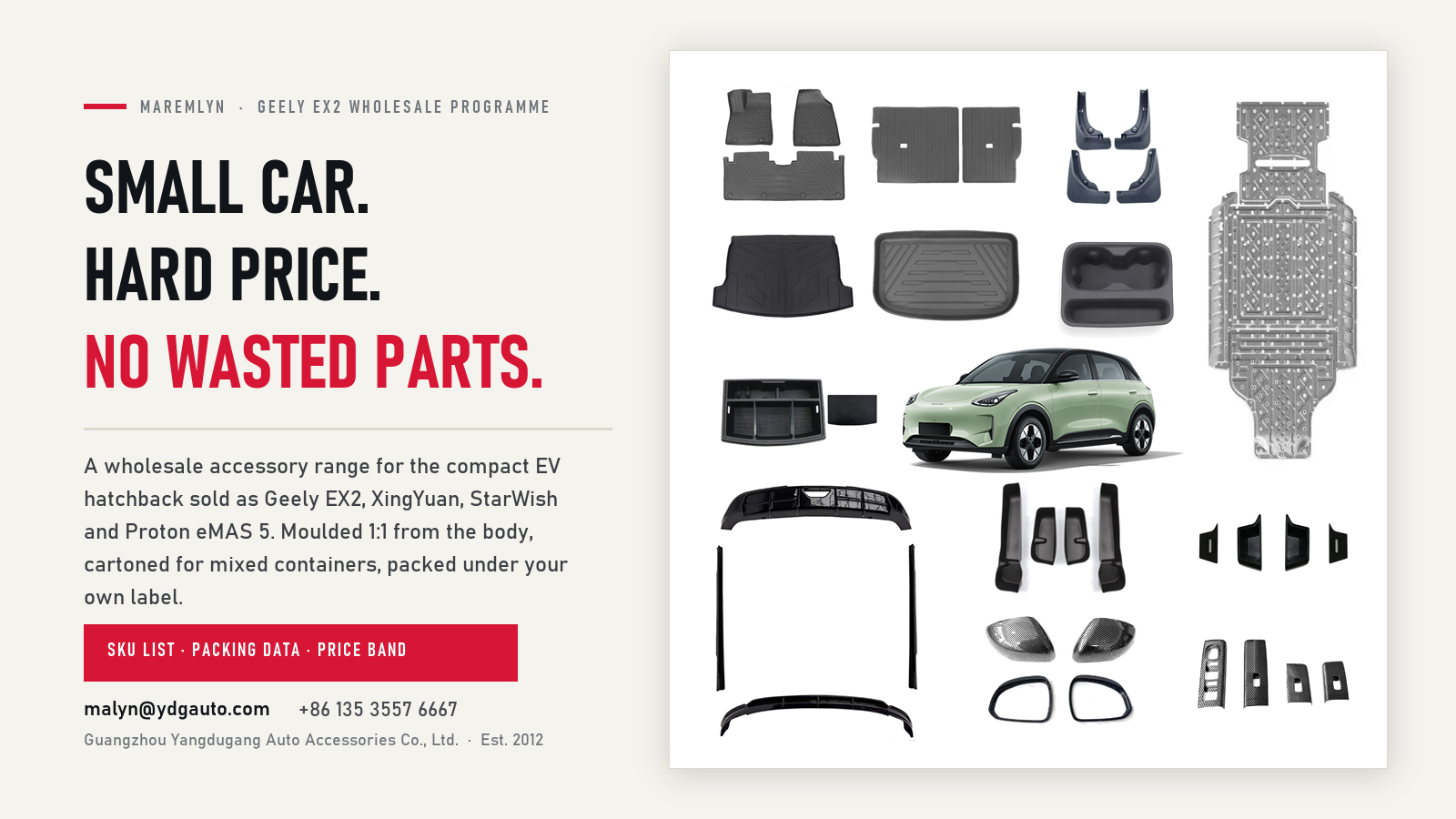
A wholesale accessory programme for the compact EV hatchback sold as Geely EX2, XingYuan, StarWish and Proton eMAS 5. Moulded 1:1 from the body, cartoned for mixed containers, packed under your own label.
The EX2 is one body wearing four nameplates. In Malaysia it reaches showrooms as the Proton eMAS 5. In China it is the XingYuan. Export catalogues read Geely EX2, and some markets list it as StarWish. Same shell, same wheelbase, same interior mouldings — and, for a distributor, the same fitment file.
What changes between those markets is not the car. It is the price the car owner will pay for an accessory. A compact EV sits at the bottom of the ladder, its buyer is price-anchored, and that anchor travels up the chain: retail price decides dealer margin, dealer margin decides your landed cost, and your landed cost decides what the factory can put in a carton. The brief for this range was written from that end of the chain, not from the mould shop.
Why the price ceiling writes the part list
On a large SUV, an accessory can be bulky and still sell: the retail price absorbs the freight. On a car in this class it cannot. A roof box, a full body kit or a heavy side-step carries the same shipping cost as it would on a seven-seat SUV, but the shelf price it can command is a fraction of it. The freight share of the retail price goes up, the dealer's margin disappears into the number, and the item stops being ordered a second time.
So the range is deliberately shaped around three properties that survive the ceiling:
- Flat and nestable. Mats, liners, plates and visors stack. Cube per unit stays low, so a mixed container still pays for itself.
- Visible protection. A part that stops damage reads as value at a glance — the owner can see what it is doing, and the dealer can explain it in one sentence.
- Re-order logic. Wear items come back. Aesthetic parts sell once per car and then wait for the next model year.
Everything else — the long tail of small trim, the novelty pieces, the parts that need a brochure to justify themselves — was left out on purpose.
One body, four badges, one fitment file
Tooling is the expensive half of this business, and duplicating it for a nameplate is the fastest way to lose the margin the price ceiling already compressed. The EX2 programme is scanned and tooled from the vehicle itself, in both left- and right-hand drive, so a Geely dealer, a Proton showroom and an export buyer in Latin America can order against the same reference.
Two details are worth putting on the purchase order rather than in the email after the container lands: which badge the market reads (the invoice and the retail listing follow the badge, not the body) and drive side. Floor mats, sill guards and underbody plates that were only ever checked on a left-hand-drive car tend to reveal their gaps at the customer's workshop.
What the car leaves out, and what that creates
Every compact EV makes the same compromises to fit a usable cabin into a short body, and each compromise leaves a gap that an accessory can close:
- A shallow well under the boot floor. Useful volume, but shapeless — anything put in it slides, and small items disappear under the load floor. The ABS under-floor organiser turns it into divided storage with a lid that sits flush.
- A front storage well instead of an engine bay. It collects dust, grit and whatever the weather brings in. A moulded liner lifts out and hoses down.
- Rear seat backs exposed to the load. They take the worst of any tip run, so the TPE set covers them in two panels that follow the fold lines.
- The traction pack under the floor. The underbody is the first thing a kerb, a ramp or a speed hump reaches — and the last thing an owner thinks about until it is too late.
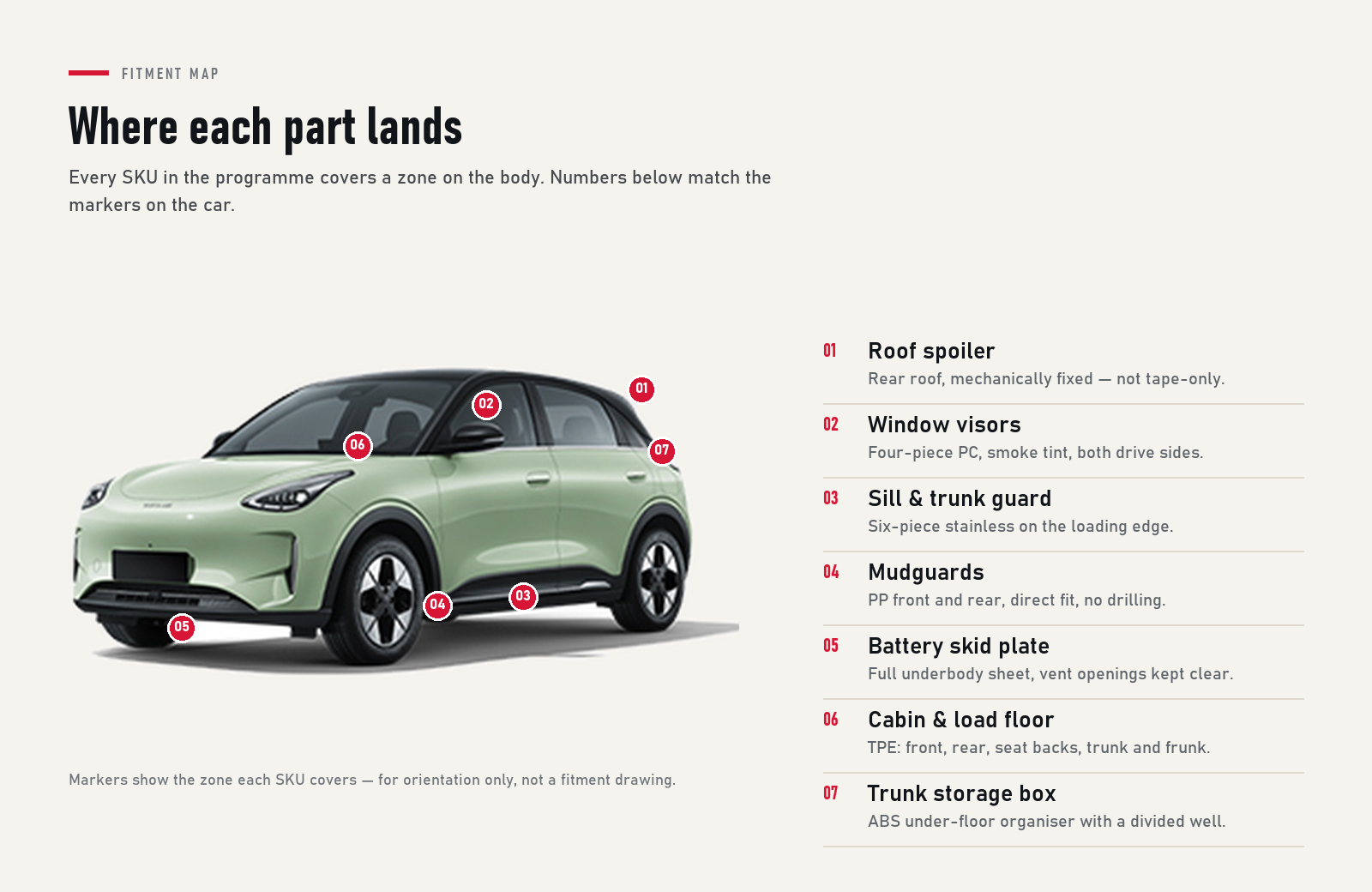
Seven zones, seven SKUs. The markers show the area each part protects or organises — orientation only, not a fitment drawing.
The protection layer: five parts that come back
1. The full TPE set — floor, seat backs, trunk and frunk
This is the SKU that decides whether a distributor re-orders. It is moulded to the floor and load-area contours rather than cut to a generic pattern, so coverage runs edge to edge and nothing has to be trimmed on the fitting bay. Raised edges and a textured surface hold mud, meltwater and daily grit away from the original carpet — which is what protects resale value on a car that will be traded in three years from now.
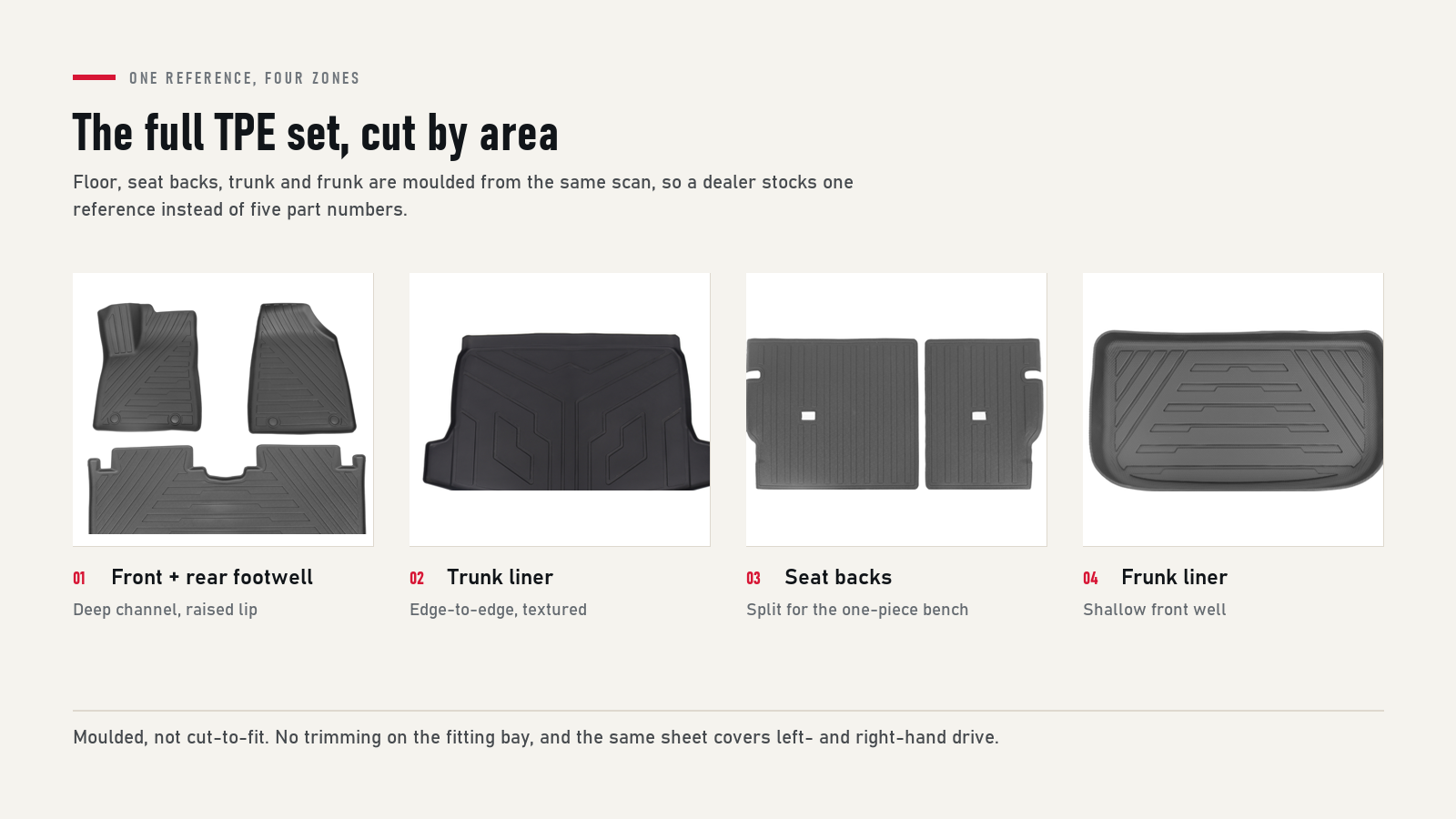
One reference, four wear zones. A dealer stocks one part number instead of five, and the same sheet covers both drive sides.
2. The battery skid plate
A full underbody sheet that aligns with the vehicle's own mounting points — no drilling, no bracket kit to lose in transit. Vent openings are left clear so airflow keeps moving, and the surface is treated against oxidation, which is the detail that matters on wet, salted or muddy roads.
3. Mudguards, front and rear
PP splash guards that take the stone chips otherwise aimed at the sills and the rear bumper. Direct fit, no drilling, and the arch lip clearance is what separates a well-tooled set from one that rubs on full lock.
4. Door sill and trunk guard, six-piece
Stainless steel on the loading edge — the first place a used car shows its age, and the cheapest place to stop it. The set covers four door sills plus the rear loading lip in one reference.
5. Window visors, four-piece
PC with a smoke tint, so rain can be kept out with the window cracked and cabin heat stays manageable in tropical markets. Four pieces, both drive sides, no drilling.
The appearance layer: the parts that sell the first unit
Appearance parts do a different job. They do not re-order on wear — they sell the car on the showroom floor, and they sell the accessory to the owner who has just taken delivery. On this platform they are worth stocking in small depth, sized to the local trim mix.
The rear roof spoiler is the clearest example. It is the single change that reads first in a photograph, which is why it earns its place in the range — but it is also the part most often ruined by a supplier who ships it with tape and nothing else. This one is mechanically fixed, so it stays on the car at highway speed rather than lifting at the leading edge after a summer.
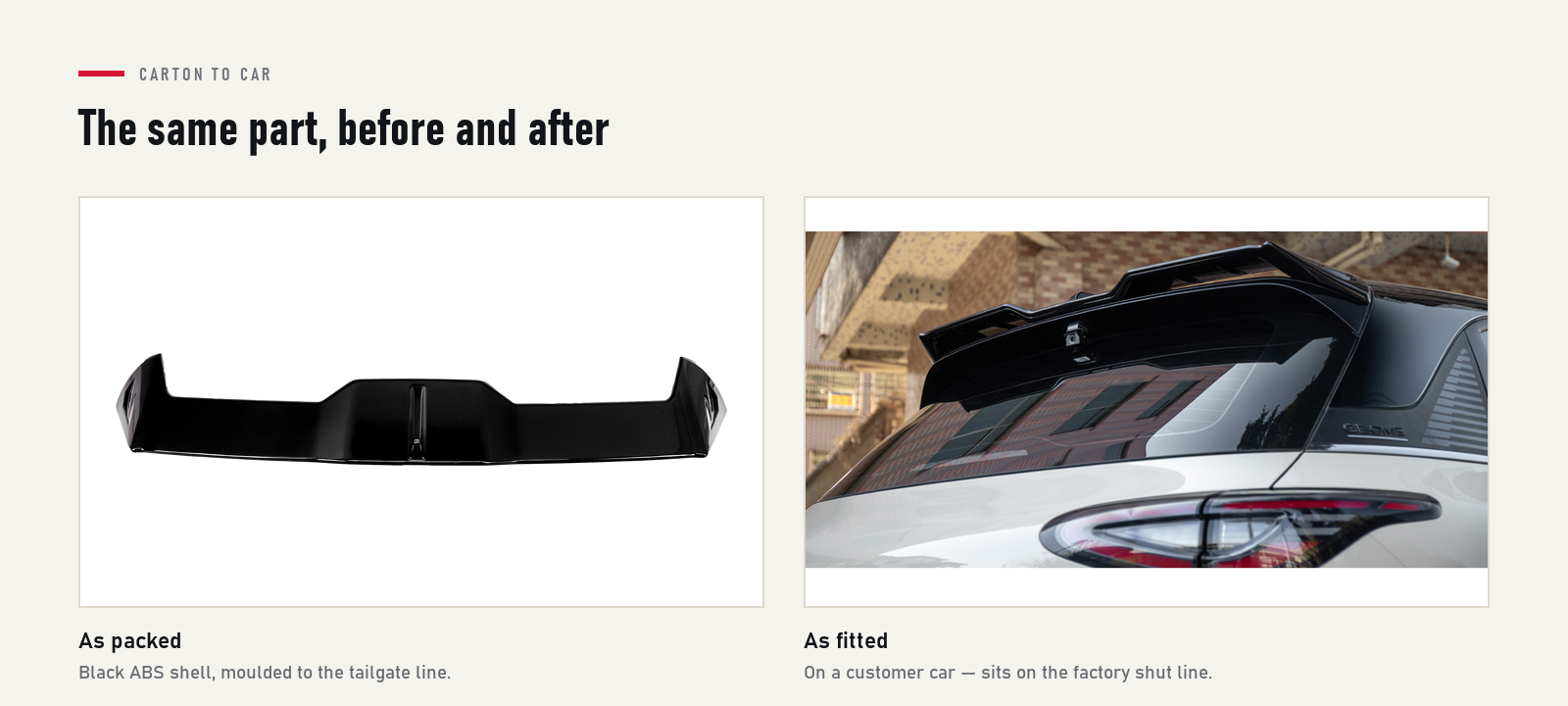
Left: the part as it ships, black ABS moulded to the tailgate line. Right: the same part on a customer car, sitting on the factory shut line.
The front lip and trim set in carbon-fibre pattern does the same job one step down: it separates trim levels visually without a bumper change. The console storage tray and the tempered screen protector are the small-ticket items that lift the average order value of a mixed carton without adding cube.
Where cheap kits fail on a compact EV
The failure modes in this category are consistent, and most of them show up within a month of fitting rather than at the quality check:
- Thin-wall TPE that curls. A mat pulled out for washing and dropped back in should return to shape. Below a certain wall thickness it does not, and the edge sits proud of the sill from then on.
- Mudguards that foul the arch liner. The gap is millimetres. A set copied from a photograph rather than a scan will rub on full lock — a claim that costs more in freight than the part is worth.
- Tape-only visors in tropical heat. Adhesive that survives a European spring lets go in a parked car in Southeast Asia. Fixings have to be part of the design, not an accessory.
- Spoilers that lift at speed. The leading edge takes the load; tape alone does not hold it. Mechanical fixing is the difference between a restock and a return.
- ABS that was never stabilised. A storage box that lives in a closed boot in direct sun will warp if the compound is not specified for it — and then it no longer sits flush.
The parts that survive a small-car price ceiling are not the cheapest ones. They are the ones whose second order arrives before the first complaint does.
Carton economics: the number that decides the re-order
On this class of car the purchase order is rarely one SKU. A distributor testing the market opens with mats and mudguards, adds the underbody plate once the first re-order lands, and takes the appearance parts when the local trim mix justifies them. That only works if the factory can pack a mixed carton and let several models share one container — which is how this range is shipped: cartons, mixed models, private-label packing on the same schedule as stock items.
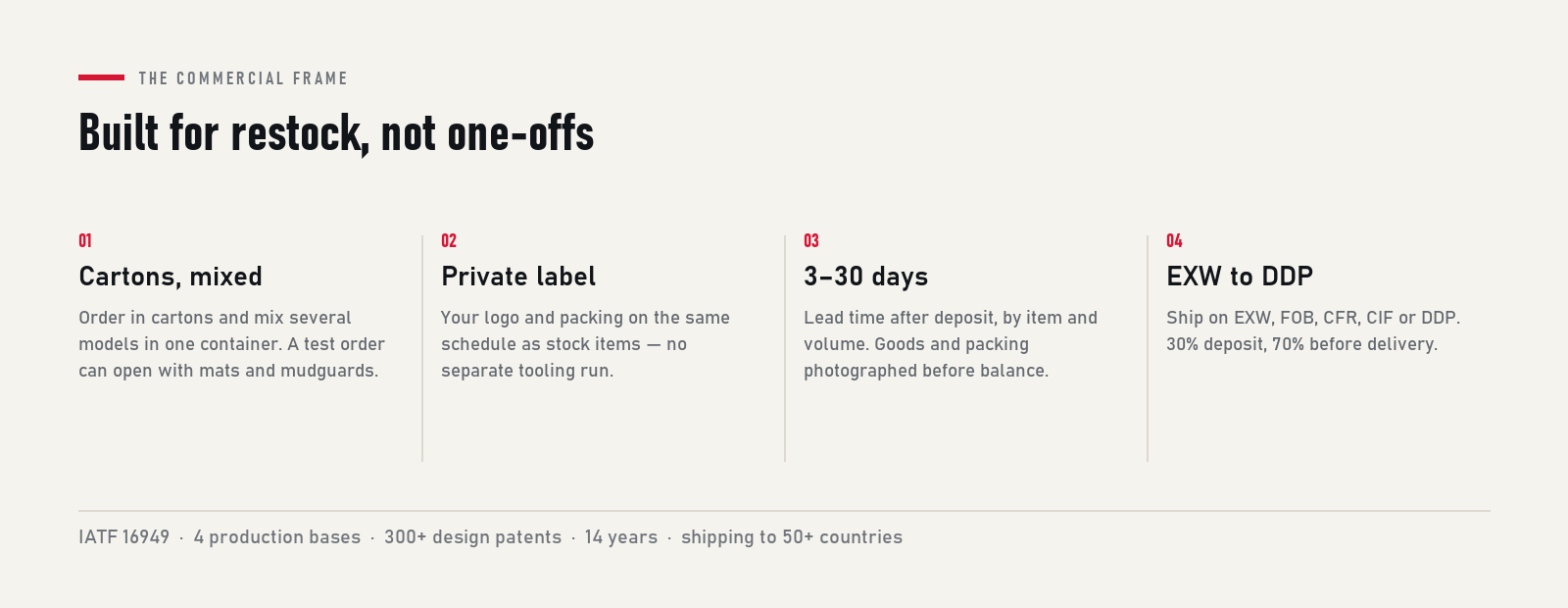
The commercial frame in four lines — the part most first orders get wrong is the carton mix, not the price.
The structure is the one the factory has run since 2012: T/T with 30% as deposit and 70% before delivery, goods and packing photographed before the balance is paid, lead times of 3 to 30 days depending on item and volume, and shipment on EXW, FOB, CFR, CIF or DDP terms. Samples are supplied against an agreed plan rather than pulled from a shelf, because odour and edge-set — the two things a spec sheet cannot tell you — are visible within a day of opening the carton.
Three answers before the quote
Wrong-fit claims cost more than the part: the return freight and the lost dealer are the real invoice. Three lines on the purchase order remove most of the risk on this platform — badge and market, drive side, and whether the market's trim actually carries the front storage well before the frunk liner ships.
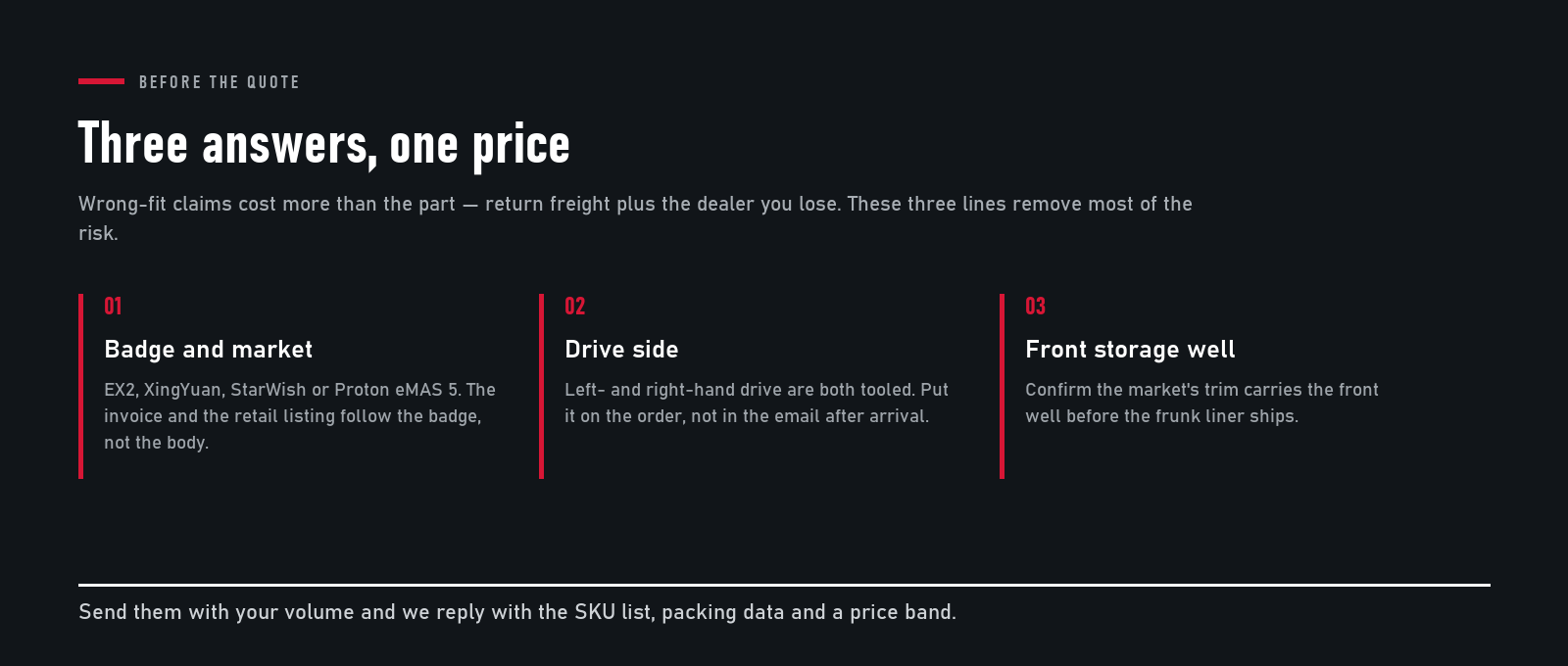
Send these three with your volume and the reply comes back as a SKU list, packing data and a price band for that destination.
Why the factory matters on a low-margin car
Four production bases and an in-house tooling team are the reason a programme like this can stay narrow and still hold a restock rhythm. Design sits with the R&D group working from 3D scans, with injection moulding, vacuum forming, blow moulding, punching and laser equipment under the same roof — so a mould correction on a spoiler does not require a new supplier relationship. The company holds more than 300 design patents, registered in China, Japan, Thailand, Australia and elsewhere; for an importer that is less about prestige than about what happens when a competitor copies the part.
Questions buyers ask
Does the same set fit the Proton eMAS 5 and the XingYuan?
Yes — it is one body under several nameplates. Confirm which badge your market reads when ordering, because the invoice and the retail listing follow the badge rather than the body.
Is left-hand drive covered?
Both configurations are tooled from the same design data. Put the drive side on the order; do not leave it to the follow-up email after arrival.
Can I mix models in one container?
Yes. Cartons can be mixed across models and SKUs, and private-label packing runs on the same schedule as stock items.
What is the lead time?
3 to 30 days after deposit, depending on the item and the volume. Goods and packing are photographed before the balance is paid.
Get the EX2 fitment sheet and the wholesale rate card
Tell us the market, the badge and the volume you are planning. We answer with the SKU list for that car, the packing data and a price band for that destination.
Request the price list Browse the EX2 range[email protected] · +86 135 3557 6667
Guangzhou Yangdugang Auto Accessories Co., Ltd. — Guangzhou, China. Est. 2012. IATF 16949 certified. Shipping to 50+ countries.
Table of Contents
- Why the price ceiling writes the part list
- One body, four badges, one fitment file
- What the car leaves out, and what that creates
- The protection layer: five parts that come back
- The appearance layer: the parts that sell the first unit
- Where cheap kits fail on a compact EV
- Carton economics: the number that decides the re-order
- Three answers before the quote
- Why the factory matters on a low-margin car
- Questions buyers ask